ISC-SIC
The International Society for Criminology (ISC) was founded in Rome, Italy in 1938. It is the only worldwide organization in the field of criminology and criminal justice. Its objective is to support activities and research designed to produce a better understanding of the crime phenomenon on an international scale. The Society promotes the prevention of crime as well along with improving the procedures used by the various criminal justice systems. Its activities, therefore, focus both on scientific and practical issues.
The International Society for Criminology is a non-governmental organization and many of its members occupy senior positions in their countries and in international institutions. The Society enjoys advisory status at the United Nations and the Council of Europe, and participates in UNESCO’s work.
The International Society for Criminology is one of the most active and influential scholarly associations at the forefront in addressing the challenges and problems posed by crime and deviance and in finding solutions that also fully respect human rights and democratic values.
The World Congresses of Criminology have been held under the auspices of the International Society of Criminology, since 1938. In this century, congresses were held in Rio de Janeiro (2003), Philadelphia (2005), Barcelona (2008), Kobe, Japan (2011) and Monterrey, Mexico (2014). All were successful, heavily attended, and well covered by the media.
The ISC publishes the International Annals of Criminology on an annual basis, organizes World Congresses of Criminology every three years, as well as International Courses in Criminology on a regular basis. The last World Congress, was held in August 2014 in Monterrey, Mexico and focused on gangs, trafficking and insecurity. The 2014 edition of the International Annals of Criminology will contain a wide range of papers from the plenary speeches at the Monterrey conference. The last International Course in Criminology was organised in Istanbul, Turkey, in May 2011 and dealt with the origins of restorative justice and its fields of application. 2021 - JANUARY 2020 - NOVEMBER 2020 - Octobre 14 C’est avec une immense tristesse que toute l'équipe du Centre vous fait part du décès, à l'âge de 51 ans, de notre très cher ami et collègue,
Carlo Morselli.
Son décès est survenu le 14 octobre 2020, au terme d’une longue et courageuse lutte menée
contre la maladie.
Impliqué de façon indéfectible au Centre depuis 2 décennies, Carlo y fut tout d’abord affilié comme étudiant-chercheur, puis comme chercheur régulier dès son embauche à l’École de criminologie en 2001. Ses qualités de leader l’ont ensuite amené à occuper successivement les rôles de directeur adjoint de 2010 à 2014, puis de directeur de 2015 à 2019.
Sa vision du CICC a grandement contribué à l'expansion et au rayonnement de ce dernier et il laisse une empreinte et une contribution à la criminologie inestimables qui dépasseront largement les limites du Québec.
CONSULTER LE TEXTE INTÉGRAL DE L'HOMMAGE RENDU À CARLO
2020 - SEPTEMBER 2018 - OCTOBER 13 Criminology pioneer and former ISC president Denis Szabo passes away:
Born in Budapest in 1929, he studied at the universities of Budapest,
Louvain and Paris. He joined the University of Montreal in 1958 where he
introduced the teaching of criminology by creating the Department of
Criminology, which served as a model for the training of criminologists
across Canada. Founded in 1969 as the International Center for
Comparative Criminology, it played an important role in the development
of comparative international research. Director of research or consultant to
different commissions of inquiry on the penal system (Prévost, Ouimet, Le
Dain), he participated in the development of a criminal policy of
humanistic inspiration in Quebec and Canada. He was a consultant to the
French and Hungarian governments.
President (9178-85) and then Honorary President of the International
Society of Criminology, he contributed to the influence of Canada in the
field of criminal sciences and criminology.
Honorary doctor of the Universities of Siena, ELTE/Budapest, Aix-
Marseille and the University Pantios of Athens, he was honorary president
of the International Association of Criminologists of French language. A
member of the Royal Society of Canada and the Hungarian Academy of
Sciences (1975), an Officer of the Order of Canada (1985), he was also a
Commander of the National Order of Merit of Hungary and the Republic of
Ivory Coast.
He is the author of numerous books translated into half a dozen foreign
languages: Incest in Urban Settings (1958), Crimes and Cities (1960),
Criminology (1965), Criminology and Criminal Policy (1978), Science and
crimes (1986), From Anthropology to Comparative Criminology (1993),
Treatise on Empirical Criminology (1994). Founder of the journal
Criminologie (Montreal, 1968). He has been Honorary Scientific Director
of the International Journal of Criminology and Technical Police (Geneva)
since 1980. His book, Crimes et villes (1960), which was based on his
doctoral thesis, got a prize of UNESCO.
Our sincere condolences to the family and friends of Denis Szabo. 2018 - SEPTEMBER 2018 - JUNE 10-14 2017 - OCTOBER 26
2017 - OCTOBER 2016 - DECEMBER 15-19
2016 - SEPTEMBER 21-24
2016 - APRIL 19
HR4DEV report 2015 online
2016 - MARCH 3-4
2015 - SEPTEMBER 2-5 2015 - JUNE 24-26 2014 - RESTORATIVE JUSTICE: AN INTERNATIONAL JOURNAL - Volume 2, Issue 1, 2014
Hart Publishing is pleased to let you know that the 1st issue of the 2014 volume of Restorative Justice is now published.
ONLINE ACCESS: To access this issue online and purchase individual papers: www.ingentaconnect.com 2014 - NOVEMBER 19-22 2014 - August 10-14 The XVII Congress takes into account some of the most serious and cogent problems facing our society these days.
NEWS AND UPCOMING EVENTS
The Stockholm Criminology Symposium: "Recognizing Knowledge to Reduce Crime and Injustice", Stockholm, Sweden, June 15-16 2021
Call for presentations: https://www.criminologysymposium.com/download/18.1f8c9903175f8b2aa70f56/1607594722427/Call%20for%20presentation%20Symposiet%202021.pdf
HOJA CRIMINOLÓGICA
SOCIEDAD MEXICANA DE CRIMINOLOGÍA: http://www.somecrim.com/hojacriminologica/107.pdf
PAST EVENTS
HOJA CRIMINOLÓGICA
SOCIEDAD MEXICANA DE CRIMINOLOGÍA: http://www.somecrim.com/hojacriminologica/106.pdf
HOJA CRIMINOLÓGICA
SOCIEDAD MEXICANA DE CRIMINOLOGÍA: http://www.somecrim.com/hojacriminologica/hoja-88.pdf
16th International Symposium of the World Society of Victimology 2018 - City University of Hong Kong, Hong Kong SAR, China
More information: http://www6.cityu.edu.hk/ss_wsv2018/index.htm
Second Distinguished Lecture on Transitional Justice by Mrs. Yasmin Sooka (Director, Foundation for Human Rights, Johannesburg
More information: https://www.law.kuleuven.be/linc/activiteiten/Distinguished_Lecture_TJ.pdf
HOJA CRIMINOLÓGICA
SOCIEDAD MEXICANA DE CRIMINOLOGÍA: http://www.somecrim.com/hojacriminologica/hoja-88.pdf
18th World Congress of Criminology - Campus of O.P. Jindal Global University, Sonipat, Haryana, New Delhi Region, India
More information: https://intercrim.com/2016congress
16th Annual Conference of the European Society of Criminology - Münster, Germany
More information: http://www.eurocrim2016.com
Reducing Prison Population: 'Custody is not the only answer' - Faculty of Law, KU Leuven Campus Brussels
More information: http://www.reducingprison.eu/downloads/files/A5_INVITO_DIGITALE_BRUXELLES_2.pdf
The Human Rights for Development report 2015 of the Advanced Summer Course on Human Rights, Development and Transitional Justice is online: http://www.hr4dev.be/documents/hr4dev-course-report-2015-final.pdf
Alternatives to Custody Project 'Reducing Prison Populations in Europe' - Université de Reims
More information: http://www.reducingprison.eu/en/
15th Annual Conference of the European Society of Criminology
Book of abstracts: http://eurocrim2015.com/Eurocrim2015_Book_Of_Abstracts.pdf
7th Annual Asian Criminological Society's Annual Conference - Hong Kong
More information on: http://www.cityu.edu.hk/ss_acs2015/
70th ANNUAL MEETING OF THE AMERICAN SOCIETY OF CRIMINOLOGY - San Francisco, CA, USA
More information on: www.asc41.com
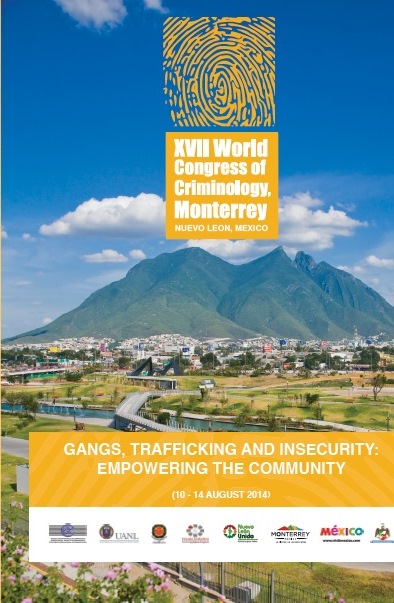
The spread of gangs involved in various criminal activities and violence is a major concern for many countries, especially since it has become internationalized.
Trafficking in people, animals, arms, legal and illegal drugs, and other goods is a major phenomenon of our times, facilitated, ironically, by technological and electronic innovations that have made travel, moving people around the globe, transferring funds internationally, and communicating instantaneously relatively easy, inexpensive, and difficult to detect.
Powerful and vast economic interests, the profit motive challenged by fierce competition, and the widespread consumerism of today are among the driving forces behind human exploitation, indentured servitude, and even slavery.
Insecurity is a foremost concern for millions of citizens in several countries who face on a daily basis the threat of crime, violence, kidnapping, sexual and other assault, break-ins and theft of their valuables. Thousands are at times forced to move to other parts of a city or of a country or even migrate in order to avoid victimization.
Thus, the Monterrey Congress will provide a platform for learning, debating and attempting to address these cogent challenges and serious problems affecting our world today from an international perspective.
The Congress welcomes different forms of presentations, from the traditional “papers” to roundtables, author meets critics sessions, literary and artistic expressions, community meetings, posters, workshops and more.
We want the Congress to be a dynamic, high energy, and creative event that offers high quality scholarly and research material, data, and insights along with more concrete, practical, solution-oriented debates and collaborations. Literature, theatre and visual arts are welcome as well.
To access the plenaries in Monterrey:Follow this link
2014 - JUNE 27-29
6TH ANUAL CONFERENCE OF THE ASIAN CRIMINOLOGICAL SOCIETY - Osaka, Japan: Advancing Criminological and Criminal Justice Theories from Asia
More information
2014 - APRIL 10
WORLD CRIME FORUM - Washington D.C., USA: The Impact and Cost of Corruption on Development and Global Business
More information (1)
More information (2)
Report
2014 - APRIL
RIVISTA DI CRIMINOLOGIA, VITTIMOLOGIA E SICUREZZA: 2014, Volume 8, Nr. 1
Read online
2013 - INTERNATIONAL ANNALS OF CRIMINOLOGY
Volume 50 - More information
Special offers - More information
2014 - JANUARY - FULL-TIME VACANCY SENIOR ACADEMIC STAFF
Full-time vacancy among senior academic staff in the area of Criminology at the Faculty of Law in the Department of Criminal Law and Criminology at KU Leuven, Belgium
More information can be found on the website of the KU Leuven
2013 - NOVEMBER 20
WORLD CRIME FORUM - Bologna, Italy: Urban security and prevention of victimization
More information
2013 - NOVEMBER 20-23
69th ANNUAL MEETING OF THE AMERICAN SOCIETY OF CRIMINOLOGY - Atlanta, Georgia, USA
More information
2013 - OCTOBER 30
WORLD CRIME FORUM - Canberra, Australia: The criminal justice system in Europe—how do people view it?
2013 - SEPTEMBER 18
WORLD CRIME FORUM DAY as part of the Crimsa Biennial Conference 2013 - Pretoria, South Africa: Exploring the nexus between research and application in Criminology &
Criminal Justice
More information
2013 - SEPTEMBER 17-20
CRIMSA BIENNIAL CONFERENCE 2013 - Pretoria, South Africa: Exploring the nexus between research and application in Criminology &
Criminal Justice
More information
2013 - AUGUST 5-7
WORLD CRIME FORUM - São Paulo, Brazil: Crime, a segurança e as metas da onu para o novo milênio
More information
2013 - JUNE 20-21
WORLD CRIME FORUM - Seoul, Korea: Information, Society and Cybercrime - Challenges for Criminology and Criminal Justice
More information
2013 - MAY 24
WORLD CRIME FORUM - Louvain, Belgium: Changing lenses to restorative justice: New directions for Europe and beyond
More information
2013 - MARCH 15
INTERNATIONAL MULTIPLIER CONFERENCE - Leuven, Belgium: Documenting Torture in Europe
More information
2012 - INTERNATIONAL ANNALS OF CRIMINOLOGY
Volume 49 - More information
2012 - NOVEMBER 14-17
68th ANNUAL MEETING OF THE AMERICAN SOCIETY OF CRIMINOLOGY - Chicago, Illinois, USA
More information
2012 - AUGUST 20-22
4th ANNUAL CONFERENCE OF THE ASIAN CRIMINOLOGICAL SOCIETY - Seoul, Korea
More information
Themes and registration
2012 - MAY 20-24
14th INTERNATIONAL SYMPOSIUM OF THE WORLD SOCIETY OF VICTIMOLOGY – Justice for Victims: Cross-cultural perspectives on conflict, trauma and reconciliation
More information
Letter of invitation
2012 - MAY
VACANCY – Professor of Criminology - University of Greenwich
More information
2012 - APRIL 28-29
WORKSHOP - San Marino, Italy: Il plagio e le sette
More information
Programme
Register
2012 - MARCH
IN MEMORIAM - Prof. Dr. Tony Peters
In Memoriam
2012 - MARCH
NOW AVAILABLE - New volume: The Criminology, Victimology and Security Review
More information
Summary
2011 - NOVEMBER 16-19
67th ANNUAL MEETING OF THE AMERICAN SOCIETY OF CRIMINOLOGY - Washington DC, USA: Breaking the Mold: Innovations and Bold Ventures in Criminology
More information


Membership

Follow us


Make a donation
Thank you for your donation.